Quick answer
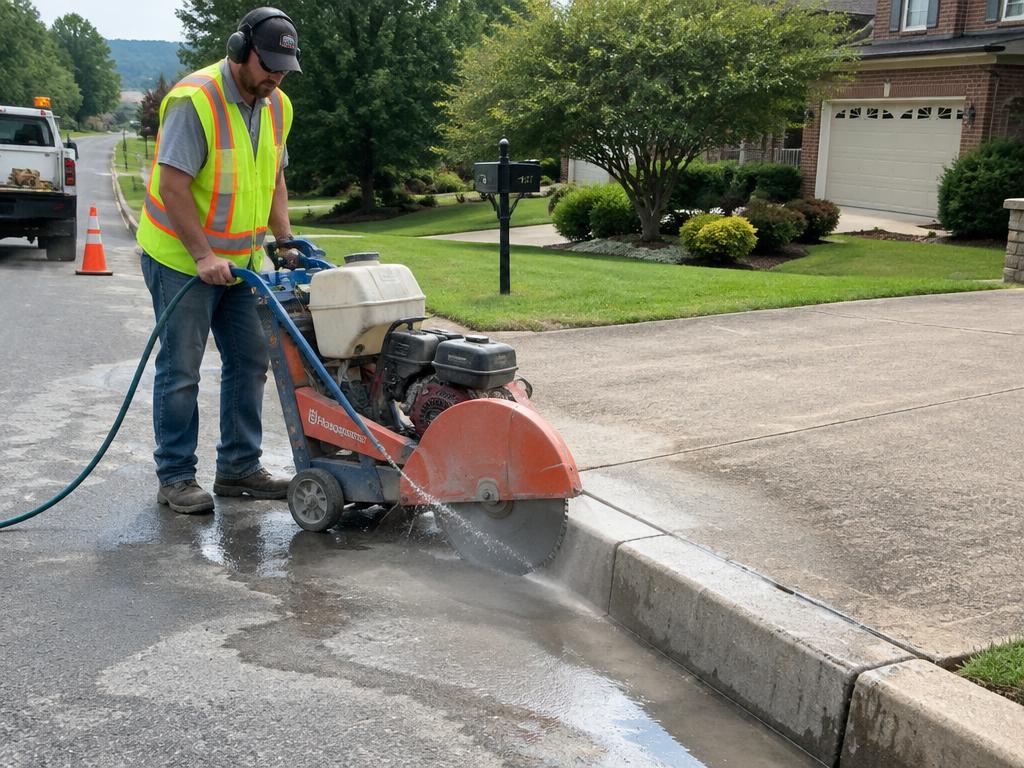
Curb cutting removes a section of an existing concrete curb so a driveway, apron, or ramp can meet the street at grade. A diamond saw makes straight, full-depth cuts on each side of the opening, and the section between them is broken out and removed, leaving clean edges for new concrete.
What is concrete curb cutting?
Saw-cutting the ends instead of breaking the curb by hand keeps the remaining curb and gutter intact and gives the finished driveway a neat, professional joint. Because curbs sit in the public right-of-way, this work is often tied to a city or county approval process.
Typical applications
- New driveway entrances and second driveways
- Widening an existing driveway apron
- Accessible curb ramps for sidewalks and parking areas
- Removing damaged or sunken curb sections for replacement
- Commercial entrances and parking-lot access points
- Curb openings for drainage inlets and utility work
Residential and commercial projects
Homeowners & residential
Homeowners usually need curb cutting when adding a second driveway, widening a narrow apron for another vehicle, or installing a parking pad for an RV or trailer.
Contractors & commercial
Site and paving contractors use curb cutting for new commercial entrances, parking-lot reconfigurations, and accessible ramps required during renovations.
Factors that affect pricing
We don't publish prices — quotes are based on the details of your project. These are the factors that typically matter:
- Length of the curb opening
- Curb style and height (barrier, rolled, or mountable curb)
- Whether the gutter pan is also cut and removed
- Removal and disposal of the broken-out section
- Traffic control needs on busy streets
- Whether the new apron pour is part of the same project
What to include in your quote request
- Width of the opening you need
- Photos of the curb from the street and from the driveway
- Whether the work is on a city street, subdivision road, or private lot
- Whether you already have approval from the city or HOA
- Your timeline for the new driveway or ramp
Safety and preparation
- Curb work usually sits in or beside a traffic lane — cones, signage, or traffic control may be needed.
- Many municipalities require a permit for any work in the right-of-way. Check with your city or HOA before scheduling.
- Buried utilities often run near curbs. Call Tennessee 811 so lines are marked before cutting and digging.
Frequently asked questions
Do I need a permit to cut my curb?
In many cities, yes — curbs are usually part of the public right-of-way. Requirements vary, so check with the City of Murfreesboro or your local jurisdiction and your HOA before work begins.
Can an existing curb be lowered instead of removed?
Sometimes a curb can be cut down to a lower profile, but most driveway openings are done by saw-cutting both ends and removing the section between them. The right approach depends on the curb style.
Will cutting the curb damage the street?
Saw cuts are precise and limited to the curb and gutter. Edges are cut cleanly so the street pavement next to the opening is left intact.
Is the new driveway apron included?
It can be. Mention in your request whether you need only the curb cut or the full apron pour, so your quote covers the whole scope.
Ready to get started?
Murfreesboro Concrete Cutting is your local source for concrete cutting, sawing, and core drilling in Murfreesboro and the surrounding communities. Call to discuss your project, or request a free quote and a concrete cutting professional will reach out to you.